
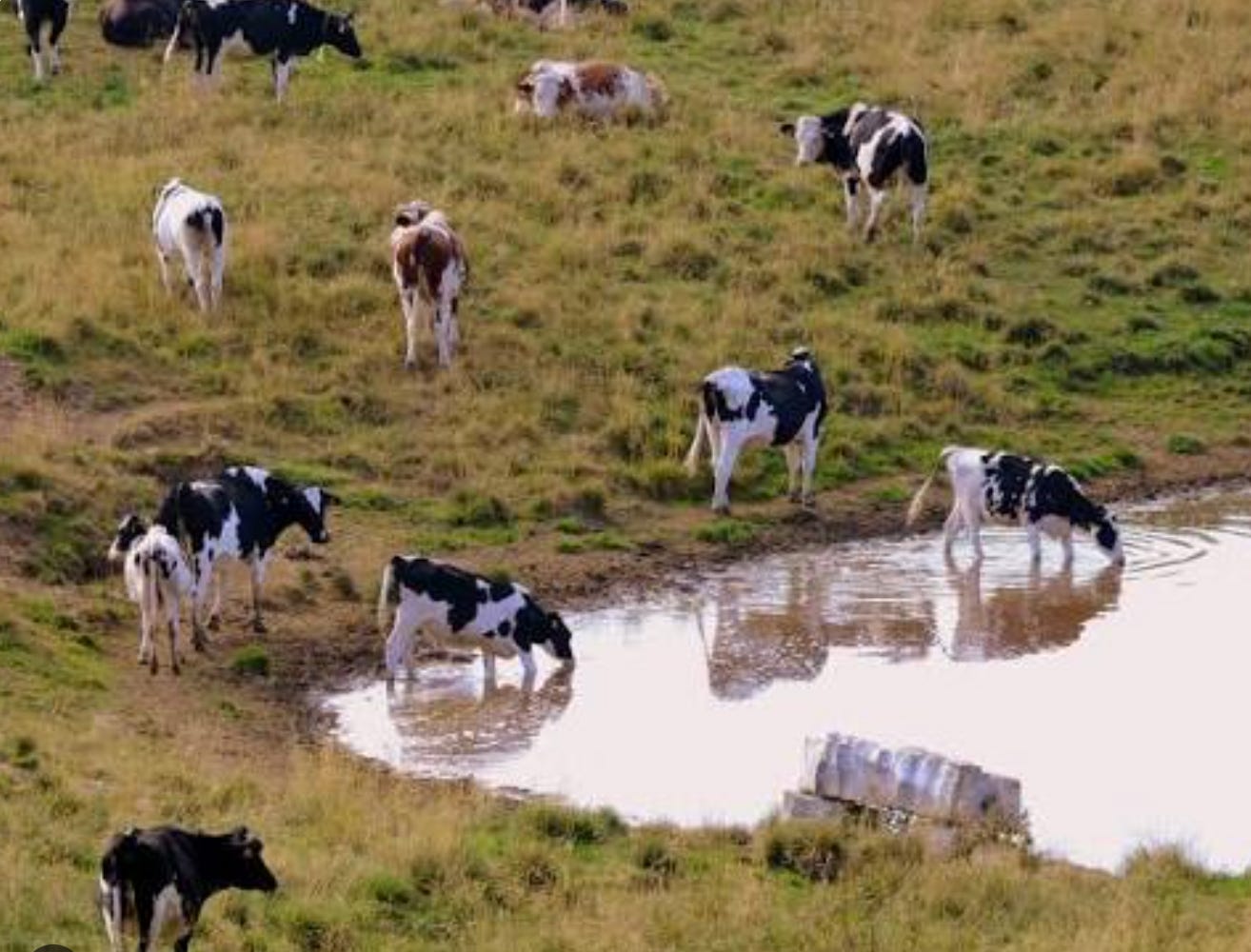
New research says that livestock’s grazing emissions exceed its enteric emissions — those cow burps that we hear about all the time in the news. This surprised me so I set out to learn how livestock grazing impacts the climate. The story has a lot to do with cutting down trees and too many cows in a pasture.
1. Corruption and wealth influence grazing in the US.
Self-described “cowboy lawyer” Karen Budd-Falen and her husband own at least five cattle or ranching operations valued at more than $1 million each. Their grazing allotments exceed a quarter million acres of public lands managed by the Bureau of Land Management (BLM). Budd-Falen has a long history suing the federal government to protect her interests, including using the anti-corruption RICO law to sue BLM staffers over enforcement of grazing regulations. Karen Budd-Falen also just happens to be the associate deputy secretary of the Department of Interior, which oversees BLM and where she has a big say in US grazing policy. Describing her job, Budd-Falen enthused: “the thing that was probably closest to my heart was grazing regulations.”
“You don’t have to be an expert on land management to know that when she talks about how policy changes are going to benefit ‘private landowners,’ she’s talking about herself.” Senator Richard Blumenthal, referring to Karen Budd-Falen
It’s no wonder that the federal government has a hard time managing the land it leases to ranchers. A recent ProPublica and High Country News investigation uncovered multiple instances of politicians interfering on the side of ranchers to get around BLM and US Forest Service grazing regulations. A former BLM employee summed up the situation: Ranching interests “can be very closely tied to folks that are in power.”
2. Beef caused more natural lands to be destroyed than any other food
So why should you care about yet another instance of powerful interests winning out over land use regulations? It turns out that cattle grazing has a huge impact, not just on our land and water, but also on our climate.
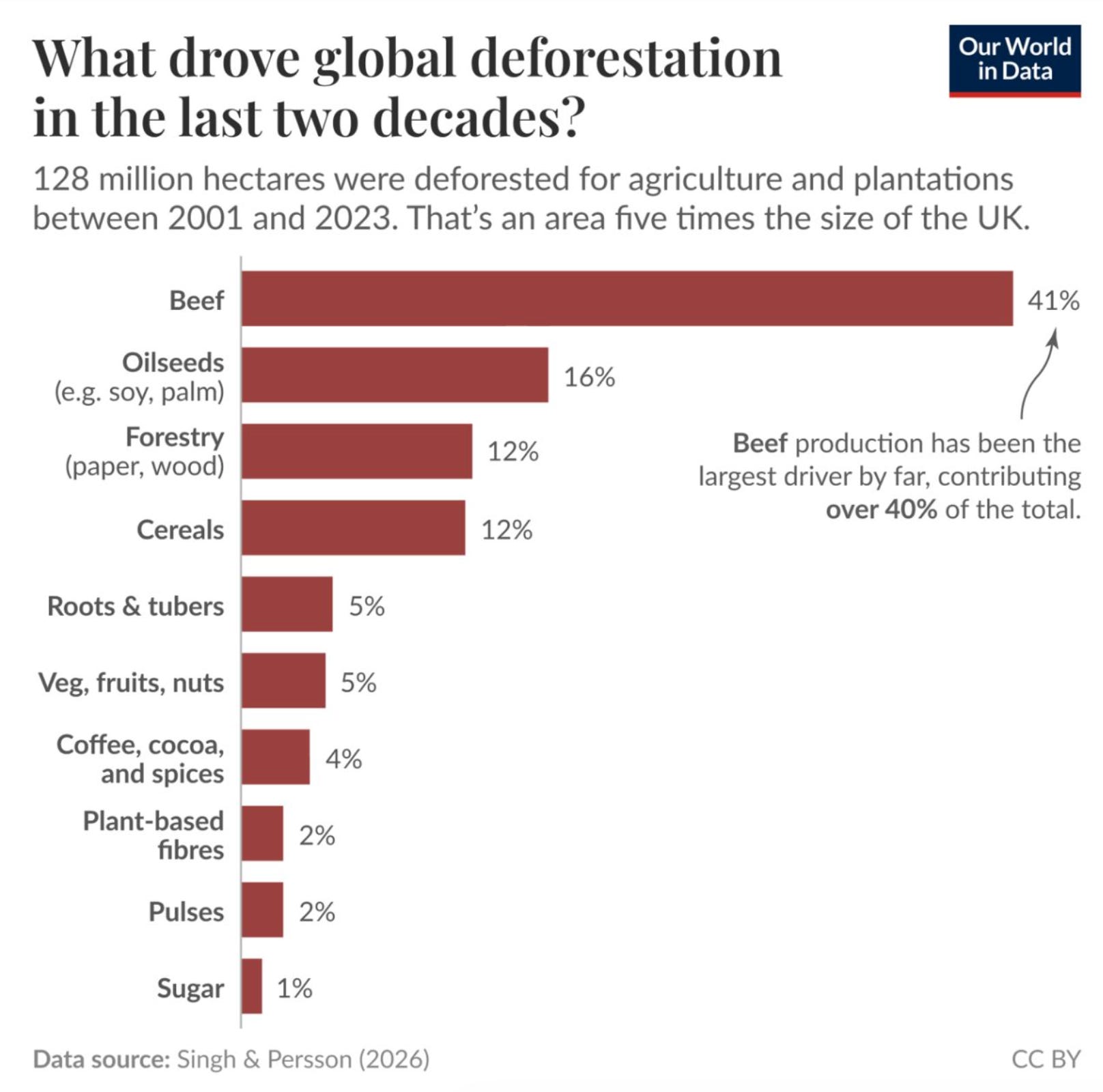
Cattle need a lot of land to graze, which explains why producing beef was the biggest cause of deforestation over the last two decades. In fact, cutting down trees for cattle grazing accounted for 41% of total global deforestation.
More than half of global deforestation for beef production occurred in Brazil. In fact, one-quarter of all deforestation this century was driven by Brazilian beef production. This has led to widespread destruction of two biodiverse ecosystems: the Amazon rainforest and the Cerrado savanna.
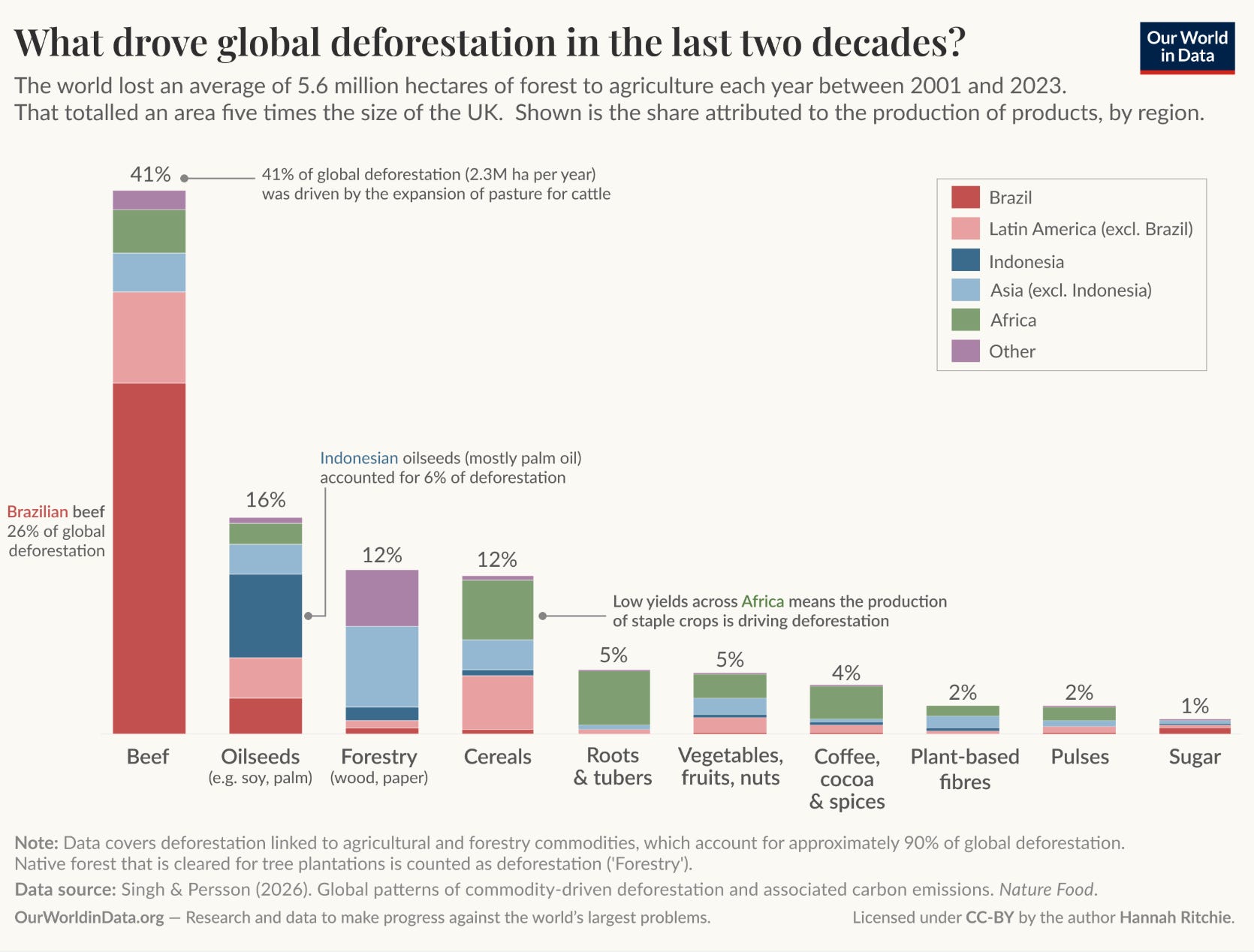
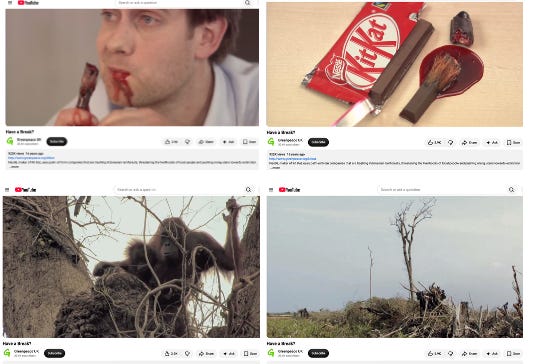
Cutting down trees for palm and soy was the second largest cause of deforestation, but rates have slowed over the last decade. This is in part because governments and food giants like Unilever and Nestle responded to consumer campaigns urging them to stop cutting down forests to plant palm oil. Activists have a lot to learn from these campaigns, including from Greenpeace’s “Have a Break” graphic video that linked eating candy bars to killing orangutans.
3. Due to deforestation and overgrazing, grazing emissions are a lot higher than we previously thought
When forests are cut down for grazing cattle, carbon stored in the plants and soils is released to the atmosphere. And when pastures are overgrazed, additional carbon is lost. During past decades, grazing has caused the loss of soil carbon equivalent to more than four years of global fossil fuel emissions.
Livestock is responsible for about 12% of total greenhouse gas emissions. Methane from cow burps has been cited as the main contributor. But our understanding of the relative importance of enteric methane emissions — and of livestock’s contribution to total greenhouse gas emissions — may be changing. A recent study examined grazing emissions more carefully. It found that overgrazing and converting forests to pasture (so-called land use emissions) were responsible for 62% of livestock emissions, while enteric and manure emissions combined accounted for only 17% . This stands in stark contrast to Our World In Data calculations, which attribute 56% of beef emissions to enteric emissions and manure, and 23% to land use change. Although these conflicting results may sound like scientists have no idea what they are doing, it’s normal for us to upgrade our understanding as more data become available.
Still I wondered why the recent study produced such different results from past research. So I asked MIT scientist Shuai Ren, the first author on the recent study. He explained that his study accounted for the fact that cows eat the plants in a pasture. Dr Ren and his collaborators calculated how much carbon the plants would have captured if they had been allowed to grow. Unlike previous research, they included the emissions from reduced plant growth in their calculations of grazing emissions. This led to higher greenhouse gas emissions from grazing than had been calculated in previous studies. Dr Ren added that even when we don’t take reduced plant growth into account, grazing emissions are higher than enteric emissions. This is because of trampling and overgrazing, which lead to erosion of the soil that had stored the carbon.
I concluded that although scientists may disagree about exactly how to measure different livestock emissions, we need to take grazing emissions more seriously than we have in the past. Total livestock emissions may also be higher than we previously believed given this new research on grazing.
4. Grazing could be managed to decrease these emissions
The good news is that we know how to manage grazing to put carbon back into the ground, where it can be stored for the long term. Managing grazing for healthy soils is about fine tuning the tipping point between too little and too much grazing. When the number of cows remains under that tipping point, grazing can stimulate the growth of plants by reducing competition for light and water. More plants means more carbon capture from the air, more carbon transferred to the plant’s roots, and more carbon stored in the soil. But when land is overgrazed, the plants are not there to capture carbon, let alone to hold the soil in place. The soil, now exposed to wind and rain, is carried away and with it the carbon it had been storing, sometimes over millennia.
The challenge for environmentally-concerned ranchers is that the tipping point between too much and too little grazing varies depending on temperatures, soils, rainfall, and other factors. So climate-friendly grazing practices, such as how often to rotate cows to another pasture, need to be designed for specific regions and even particular ranches. Regenerative farmers are at the forefront of trying to determine how to manage grazing to ensure healthy soils that store carbon.
5. Improved grazing means more animal feed and more animals elsewhere
The bad news is that optimizing grazing globally, while important, can only sequester a third of the soil carbon needed to offset livestock emissions. This is in part because when cows eat less grass in pastures, they need to get their nutrients elsewhere — from corn, soy, and other feeds. This has some benefits in that cows digest feeds more readily than grass, which leads to fewer cow burps and lower enteric emissions.
The benefits of regenerative agricultural practices may come with trade-offs such as increasing emissions somewhere else in the supply chain. Lunch is never entirely free. Steve Davis, Professor of Earth System Science, Stanford University
So is cows spending less time grazing a net positive for the climate? Not necessarily. The answer depends on where the feed is coming from. If the feed comes from the US, which has a relatively low rate of cutting down forests or plowing up grasslands to grow corn and soy, and produces corn and soy efficiently, then we can get net climate benefits of less grazing and more feed. But if the feed comes from countries like Brazil that are still cutting down forests to grow feed, then the benefits are questionable. This makes me feel a little uncomfortable — it seems unfair to “blame” Brazil for more emissions than the US, since the US already emitted all that carbon when we converted our native forests and grasslands to corn and soy. Still, if we are only looking at the situation today, producing corn in the US emits less than growing corn in Brazil.
Scientists have calculated that optimizing grazing could sequester about 4% of annual human emissions. But if we add emissions from increased feed production, the net climate benefits drop by up to 31%. By my calculations this means that optimized grazing could still sequester around 3% of annual human emissions.
6. Optimized grazing can be combined with reducing meat consumption to further reduce emissions
Throughout my research for the Food, Farms, and Climate substack, I have struggled to unpack myriad supply and demand side solutions and their tradeoffs. In addition to optimized grazing leading to more grain-fed livestock, fewer cows on pastures can mean more cows raised in industrial CAFOs (confined animal feed operations). These supply side tradeoffs inevitably lead me back to the same conclusion: the imperative to reduce beef consumption — a demand side solution — in the US and other high beef consuming countries. Why? Because supply side interventions can only lower cattle emissions so far. (Another supply side intervention — feed additives — has the potential to reduce cow enteric emissions by up to 30%, but that still leaves us with the massive grazing and manure emissions.)
Yet if we combine supply (cattle raising) and demand (eating less meat) strategies we could reduce ruminant livestock emissions by up to 91% by 2100, while still affording everyone a healthy diet. Notably, 71% of countries could achieve neutral or negative net ruminant emissions by 2100. In short, we need to combine eating less beef with more sustainable beef production to meet our climate goals.
Of course, reducing meat consumption can be just as challenging as controlling ranching in the US. Like ranching, eating beef is an American tradition. And as I wrote about in my recent substack, beef is also subject to payoffs from big meat producers. In short, there is ample room for citizen action to confront the corruption, change our eating habits, and make our food systems sustainable.

TAKE ACTION
According to the ProPublica and High Country News investigation, grazing fees on federal lands come with a 93% discount compared with market rate for forage on private land. The reporting also found that, in 2024 alone, the federal government poured at least $2.5 billion into subsidy programs that public lands ranchers can access. What’s more, a lot of these subsidies appear to be going to the wealthy, including Rupert Murdoch, as well as to mining companies and public utilities. The Trump administration is further increasing these subsidies while getting rid of staff with the expertise to help ranchers adopt more sustainable practices.
Urge Congress to pass the Agriculture Resilience Act. This act, championed by House Democrat and farmer Chellie Pingree of Maine, prioritizes more sustainable grazing practices, including management-intensive rotational grazing, in farm conservation programs.
For decades, Western watersheds project has been fighting the giveaway of our/federal lands to grazing. It also ruins riparian habitats in the West.
The term “regenerative practice” with regards to beef production appears just to be another instance of greenwashing