
by Marianne Krasny
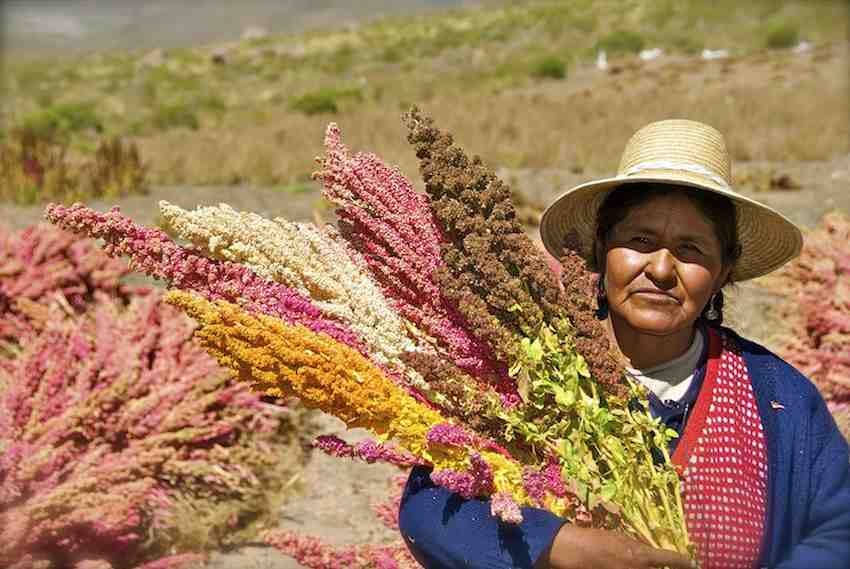
In “The Quinoa Bust: The Making and Unmaking of an Andean Miracle Crop,” anthropologist Emma McDonell tells a compelling story weaving together Indigenous farmers high in the Andes Mountains of Peru with agribusiness, science, and health-conscious Western consumers. Here I draw from her work and from nutritional science to help you eat healthy meals — and to gain insight into the challenges of creating a more equitable and sustainable agriculture.
In 1953, food scientists made an astonishing discovery. Quinoa, an obscure crop raised by indigenous farmers high up on the shores of Lake Titicaca in Peru, has a nutritional profile superior to that of cow’s milk. At a time when milk, meat, and wheat were considered the foundation of a superior diet, the attention of a growing number of researchers and development organizations turned to this “superfood.” Could it help solve global hunger and malnutrition? Could quinoa also become a “miracle crop” — integrating indigenous knowledge, adaptation to harsh conditions, and biodiversity? And could quinoa become a more equitable and sustainable alternative to the “expert-driven” Green Revolution — with its singular focus on increasing the productivity of a small number of crops using fertilizers, pesticides, and breeding?
In the past 70 years, quinoa has become a much-coveted food, from high-end Peruvian restaurants to the tables of Westerners seeking novel plant proteins. It also spurred a boom in Peru’s rural economy, raising hopes of improving the standard of living of indigenous Peruvians. But this boom was followed by a disappointing bust.
So what have we learned about quinoa — its health benefits and its global market? And what can quinoa tell us about keeping farming sustainable when a crop captures the world’s appetite and imagination?
Is Quinoa Really a Superfood?
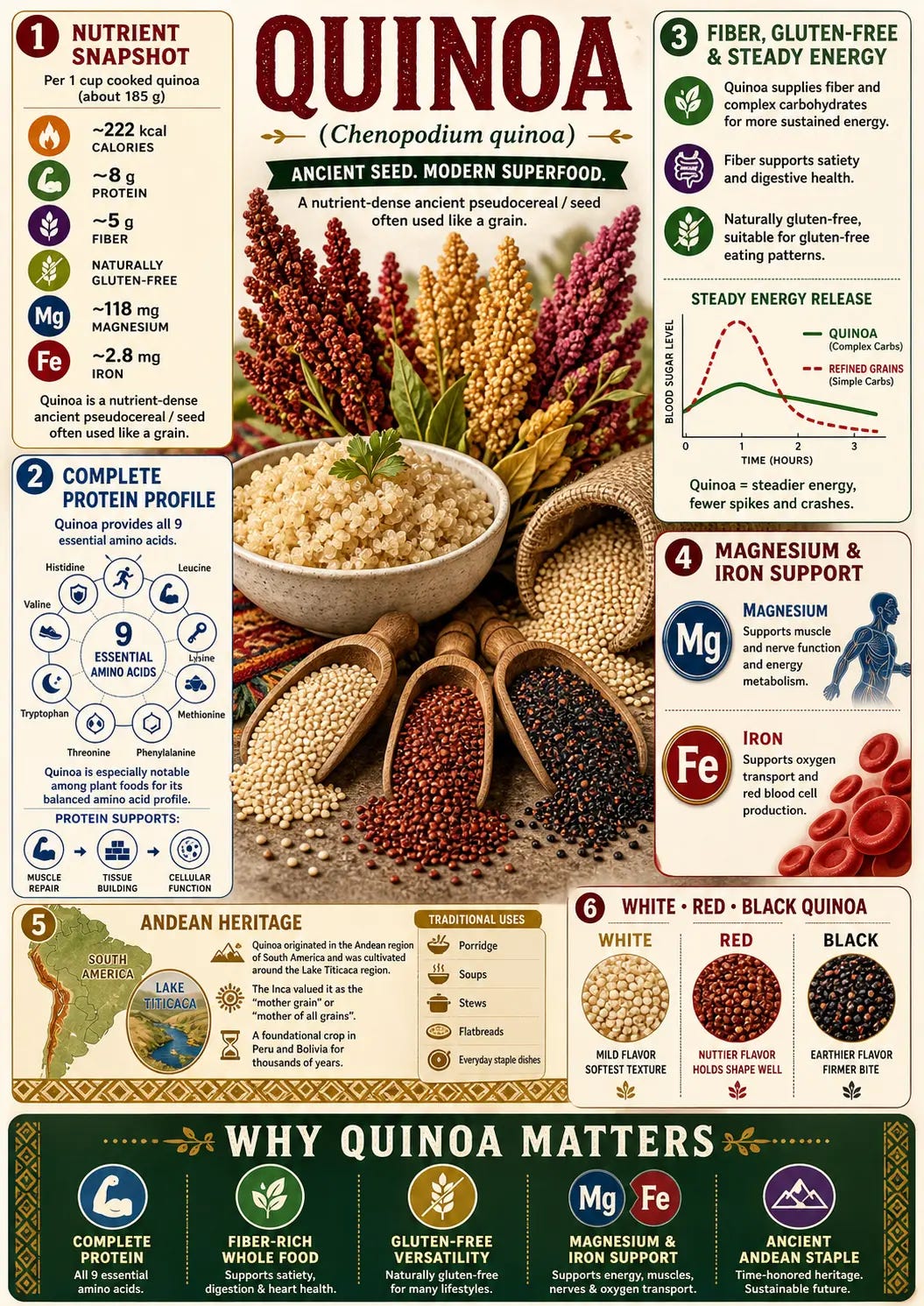
Quinoa has an exceptional nutritional profile. It has more protein than milk and whole wheat. But what’s most remarkable among plant proteins: quinoa is also a good source of all nine essential amino acids. Most plant proteins have some but not all the required amino acids, which is why we mix beans with corn, or rice with tofu. But quinoa can serve up the same protein benefits as milk or meat on its own.
Quinoa is also higher in fiber than brown rice or yellow corn. It is gluten free and has a low glycemic index, which is linked to a lower risk of diabetes and cardiovascular disease. Quinoa is a good source of antioxidants, which can reduce inflammation, and of required minerals, including manganese, phosphorus, copper, folate, iron, magnesium, and zinc. Quinoa’s polyunsaturated fatty acids have an omega 6 to omega 3 ratio close to that of a healthy diet.
Quinoa packs more nutrients than most other grains and is relatively high in quality protein. It’s rich in vitamins, minerals, plant compounds, and antioxidants. Quinoa is gluten-free, may help lower blood sugar levels, and aid weight loss. If you want to increase the nutrient content of your diet, replacing other grains like rice or wheat with quinoa may be a good start. Health Line
So what’s not to like about quinoa? A few things, but none of them major for the average consumer. Quinoa has higher levels of oxalates than potatoes or rice, but lower levels than its Chenopod family relatives, beets and spinach. Since oxalates can lead to kidney stones, those at risk of this condition may want to avoid eating excessive amounts of quinoa. Quinoa also contains saponins, which are responsible for its bitter taste and can occasionally cause stomach irritation. (Saponins also may lower cholesterol and contribute to quinoa’s ability to lower the risk of heart disease.)
Today, most quinoa sold in supermarkets has low levels of saponin. Some nutritionists recommend soaking quinoa seeds for 30 minutes to remove saponin. I simply rinse my quinoa before cooking, which seems to remove the bitter taste. Rinsing also gets rid of some of the oxalates; more are removed through cooking and then discarding the water.
So, is quinoa a superfood? My answer is yes, based on quinoa’s exceptional nutritional profile. Quinoa is also easy to cook — it does take a couple minutes to wash away the saponin using a fine sieve, but after that you simply boil quinoa for 12-20 minutes (the black and red varieties take a little longer than the white varieties). Cover your cooked quinoa with some vegetables and you have a meal that’s healthy for you and the planet. Or you can buy any of the myriad quinoa products — quinoa burgers, quinoa sausages, quinoa milk, quinoa yogurt, quinoa powders, quinoa-based energy bars, and even quinoa chips and puffs.
Yet, questions remain about what a superfood for health conscious consumers in the US and Europe means for impoverished and malnourished quinoa farmers in Peru. Can the demand among well-nourished consumers in the Global North help quinoa farmers earn a livable income and gain access to proper nutrition? And can a crop whose genetic diversity and traditional growing practices have allowed it to adapt to the harsh conditions of the Altiplano over millenia retain its diversity so that it becomes not just a superfood but also a miracle crop?
There are hundreds of varieties of quinoa, ranging from bright magenta to jet black and varying in size, shape, taste, and, perhaps most critically, agronomic characteristics such as vulnerability to temperature extremes and average yields. The Quinoa Bust
Is Quinoa a Miracle Crop?
As knowledge of quinoa’s remarkable nutritional profile spread, the world took note. The UN proclaimed 2013 the International Year of Quinoa. Middlemen promised indigenous quinoa farmers high prices for their crops. The miracle crop would become a way out of poverty — indigenous people high up in the Andes would be able to afford electricity and indoor plumbing, and to send their children to study at a university.
For the Peruvian altiplano, a region largely left out of the country’s decade of dramatic economic growth and commonly dismissed by Peruvian elites as a cultural backwater, quinoa’s rise to global stardom was considered an unparalleled rural development opportunity. The Quinoa Bust
Perhaps even more exciting, quinoa promised a new model for development. No longer would feeding the world depend on breeding a small number of crops — corn, rice, and wheat — into “improved” varieties. No longer would producing the world’s food depend on synthetic fertilizers and pesticides. And no longer would traditional knowledge and cultivation systems be decimated in the name of progress. Instead, development agencies would respect the local knowledge of the world’s poorest farmers, and pay them fair prices for what they produced.
“We have more than fulfilled our goal. Leaving behind centuries of neglect, it is with renewed strength that quinoa begins a new phase as a food for the future.” FAO Director General Graziano de Silva during the International Year of Quinoa closing ceremony in December 2013. The Quinoa Bust
In fact, prices paid to the indigenous Andean farmers did go up, as the global market for quinoa expanded. By 2014, quinoa prices were seven times higher than they had been in 2008. By this time, wealthier farmers had started raising quinoa on large farms in the lowlands along the Peruvian coast where quinoa had never before been grown. They began to cultivate low saponin varieties, which would not taste as bitter as those grown in the highlands. In 2014, quinoa production doubled over the year before thanks to the lowland production. Prices skyrocketed to record highs.
But 2014 also marked the year inspectors at US ports rejected several containers of Peruvian quinoa that exceeded allowable levels of pesticides. Undoubtedly the chemicals were from quinoa produced on the large farms in the lowlands. But regardless of the source of the chemicals, quinoa prices the next year fell by almost 40%. The quinoa boom had turned into the quinoa bust.
In a talk I recently attended at Cornell, anthropologist Emma McDonell recounted a particularly poignant story of how the global market led to broken promises for highland farmers. A farmer named “Maria” had had a particularly good harvest and was looking forward to the quinoa buyer arriving at her village. But first, a tecnico, who was trained to discern the quality of quinoa for the global market, arrived to inspect her harvest. She looked over Maria’s quinoa and found too many unripened seeds mixed in with ripe seeds. In fact, the seeds of quinoa grown in the highlands had always ripened at different times — this was to be expected in a crop as diverse as quinoa. But with competition from the lowland farms and the requirements of new Western markets, Maria’s dreams of earning a decent price for her quinoa were dashed. The same traditional practices that had attracted development specialists to quinoa as a miracle crop now made traditional cultivation unacceptable.
Farmers high up in the Andean Altiplano, whose ancestors had domesticated quinoa eight thousand years earlier, had been brought into the modern market, only to be kicked out by the very practices that had led to the world’s interest in quinoa in the first place. They became victims of the quinoa bust.
The bust foreclosed the sense of possibility quinoa had helped foster …. It forced actors invested in quinoa to acknowledge that the better future quinoa was supposed to usher in was still out of reach. The quinoa miracle was a mirage. The Quinoa Bust
Today, quinoa is still grown in the Andes and along the coast. Peru and Bolivia are by far the world’s largest producers. Farmers on the high Altiplano earn more money than before the world discovered quinoa. But the promise of quinoa becoming a miracle crop that would bring them out of poverty and change the face of agriculture never materialized.
*********************************************************************************************************
Despite farmers’ and development agencies’ dashed dreams, quinoa seems to have survived its boom and bust. Its reputation as a superfood remains untarnished. From 2023-2024, the US quinoa market grew an impressive 47%, signaling a surge in demand. The demand is expected to continue to grow, as more and more Western consumers seek out nutritious and healthy foods.
Yet quinoa failed to provide a model for moving beyond the Green Revolution toward a more sustainable and resilient agriculture. We are still looking for what will.
TAKE ACTION
Try out several quinoa recipes and invite your friends over to share the ones you like best. They might be interested in this quinoa nutrition factsheet.
I love quinoa as a replacement for often arsenic-laden rice. Although the myth of requiring the combining of amino acids for 'complete protein' at each meal has been laid to rest, it's good to be reminded that quinoa offers all of the essential amino acids. Thanks for this informative piece!
Love me some quinoa.