

What is right and what is wrong with this statement?
As a family farmer, I am very concerned with America’s prime farmland being covered with tax-payer subsidized solar panel installations. Food security is national security, and if we cover our prime soil with Chinese solar panels, we will become dependent on our adversaries to feed American families. Mary Miller, US House of Representatives, R IL
Let’s delve into the solar-energy vs farms debate.
“Food security is national security”
While Representative Miller’s statement has merit, solar installations are not a threat to our food security, especially compared to the 30 million acres of US prime farmland that grow corn to produce ethanol. Corn ethanol is obviously not increasing food security on the land where it is grown. It also reduces food supply in the Gulf of Mexico. How? Growing corn requires fertilizers (much of which come from Russia and Canada). A lot of that fertilizer runs off into the Mississippi River and its tributaries, ending up in the Gulf of Mexico. There it produces the “dead zone” at the mouth of the Mississippi River, an expanse of water with low oxygen roughly the size of New Jersey. Because fish, crabs, and shrimp cannot survive in the dead zone, fishermen have to travel further and further from shore to earn an income and supply food for our tables.
While the vast acreage in corn ethanol does not increase our food security, it does supply about 5% of US energy. But solar arrays generate the same amount of energy as corn ethanol in just 3.2% of the land. In other words, to produce the energy generated by one acre of utility-scale solar requires about 31 acres of corn-ethanol. According to the US Department of Energy, we would need only 10 million acres of land — or 0.4% of the area of the United States — to supply all of our nation’s electricity using solar. Currently, about three times that amount — 1.3% of US land — is occupied by corn grown for ethanol.
Perhaps instead of ranting about Chinese solar panels and food security, Congress could consider how to support domestic production of solar panels. They might also consider how some corn ethanol could be transitioned to agri-voltaics — that is raising sheep, vegetables, and other high value crops alongside solar panels. In short, food security and renewable solar energy are compatible, but could use a little help from friends in Congress.
We demonstrated that even small injections of ecologically informed, highly efficient solar in vast cropland landscapes, largely used to produce ethanol fuel, can lead to great potential benefits for people and planet. Steven Grodsky, US Fish & Wildlife Service and Cornell University
Can we install solar on abandoned rather than prime farmland?
Congress could also switch the focus from prime farmland to abandoned farmland. In rural parts of NY and other northeastern states, abandoned farmland dominates the landscape. The challenge is that solar panels need to be installed close to power transmission lines.
In NY, 65% of land is within 5 km of a transmission line, enough to support even the most ambitious solar development. But the land close to transmission lines is often prime farmland. Transmission lines are generally installed on flat land with rich soils, whereas less productive and abandoned farmland is on the rocky hills distant from transmission lines. This explains why there is a lot of discussion among renewable energy enthusiasts about expanding the grid infrastructure in rural areas. If this were to happen in New York for example, thousands of acres of abandoned farms, which have limited other uses for humans, could be converted into solar farms.
Abandoned coal mines and power plants are also possible sites for solar arrays. Some have proposed putting solar on top of parking lots and highways. This will require government incentives because costs are higher to build arrays over existing structures than on flat land close to transmission lines.
The issue is not how much land solar takes up — if solar were to supply all our needs, it would take up only 0.4% of the area of the US. Rather the issue is what kind of land is converted to solar.
A hopeful development is that solar panels are getting more and more efficient, meaning we need less land to produce the same amount of power. Currently, solar arrays vary widely in how efficient they are, with some using more than twice the land per megawatt as others. We can expect panels will become even more efficient in the future.
Solar installations can provide habitat for pollinators and wildlife
Given the right land management practices, pollinators and wildlife can benefit from solar arrays. Researchers in Minnesota restored native plants after installing solar arrays on land that had been used for row crops. Over each of four years after this “solar-pollinator” project was created, insect numbers and the diversity of insects went up, including for native bees. In a plus for food security, the number of bees visiting adjacent soybean fields was comparable to the number of bees visiting from a nearby conservation site. In another plus for our food supply, my Cornell colleague Leana Zoller led a study of agri-voltaics in New York, showing that light grazing by sheep can increase insect pollinators. In other words, we can combine solar arrays with pollinating our crops.
Of course, solar arrays in Minnesota and New York are small compared to “industrial solar” in the Southwest. In the US’s top solar states, California, Nevada, Texas, and Arizona, you can come across utility-scale solar projects as large as 7000 acres. Since these are often installed in the desert, there is little concern about loss of farmland. But just because they are in the desert doesn’t mean they don’t have other impacts —possibly on desert wildlife.
A study of the desert kit foxes around industrial scale solar farms in California showed that the foxes roamed widely through the solar arrays, often on a daily basis. Another study looked at how mega solar projects in California could avoid harming the threatened desert tortoise. The authors came up with recommendations, including using elevated mounting systems that preserve more of the natural desert floor, and installing tortoise culvert crossings under access roads. In short, extra care and likely extra money are needed to build wildlife friendly solar arrays.
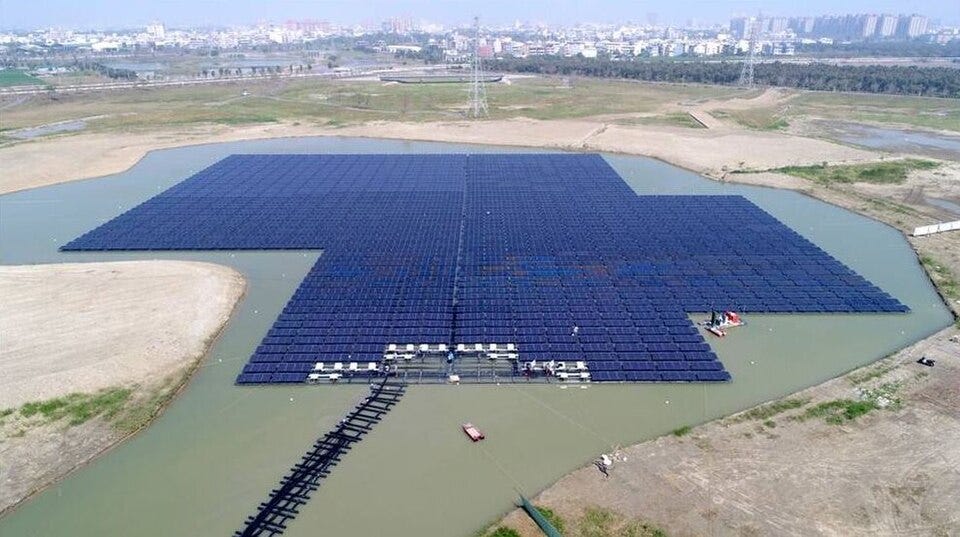
Can solar panels be installed on ponds and reservoirs?
Placing solar panels on ponds or lakes can spare prime farmland land to grow food. For these reasons, floating solar is growing rapidly, especially in densely populated countries such as China, South Korea, India, and Japan. Solar panels can be installed not only in ponds, lakes, and coastal areas, but also in reservoirs and irrigation channels. One cool fact about floating solar is that it cools the water and at the same time the water can prevent the solar panels from overheating, making them more efficient.
But that cooling comes from shade, and that shade also impacts the plants living in the water. Some plants die when they can’t get enough sunlight, and other plants survive under the shade but their photosynthesis slows down. Whether the plants die or operate at less than full capacity under the shade, they capture less CO2 from the atmosphere. Several steps can be taken to counter this loss of carbon, including spreading out the solar arrays over larger areas of water, and placing the panels higher above the water.
This “carbon cost” of installing solar arrays on ponds or lakes ends up being relatively small compared to the costs of other energy sources. Solar panels on land also shade plants that previously sequestered carbon. Hydropower, generally considered a renewable energy, has higher carbon costs than lake solar. This is largely due to the fact that as the water floods the area behind the hydropower dam, it kills trees or other plants that sequestered CO2. It is also due to the methane emissions that come from the decomposition of the dead trees and other plants.
Back to the farm
My colleague Steve Grodsky is a leading expert on solar facilities and biodiversity. He has conducted numerous studies on solar and wildlife and solar on farmland. Recognizing the tradeoffs between various land uses and solar energy, Grodsky has concluded that although installing solar facilities on croplands may seem paradoxical, we should definitely consider farmlands as we transition to renewable energy, especially farms that are less productive and require a lot of fertilizer and irrigation, including those growing corn for ethanol. Agri-voltaic farmers are showing us how to produce food and solar energy at the same time, and eco-solar practices are showing us how to conserve pollinators and wildlife alongside solar arrays. The future will look even brighter once Congress overcomes their irrational fears about renewable energy and decides to work with rather than against nature.

TAKE ACTION
Congress is likely to pick up the Farm Bill after the mid term elections. Click on link below to send a letter to Congress supporting agri-voltaics.
💚🐝😅We who live in the Twin Cities of M’niSota USA along the Mighty Mississippi River from Pigs Eye to Hastings (where for 20 years I taught Language Arts using the River for project-based learning) have collectively and collaboratively put together a coalition of NGOs to align interests with Excel Energy and “plant” solar panels and native species into a Pollinator Corridor stretching from the River up through suburban lands underneath the overhead power lines. It CAN be done ✅
Thank you, Dr. Krasny for your as-always illuminating and vetted research sharing in such an accessible narrative voice.
Marianne, Good stuff, thanks for your research. I'd be curious to hear what you find about on-shore wind turbines. I live in Virgil & recently there was a proposal from a German corp to install 700 foot wind turbines here. To my surprise there was an enormous local opposition in the form of an anti-turbine citizen group encouraging land owners not to lease their land. A few days ago the German developer pulled their plans for Virgil. I see there is a sizeable literature on local opposition to renewable energy.