
by Marianne Krasny
The Farm Bill is a broad piece of legislation passed by Congress roughly every five years. It directs food and agriculture in our country, but we should also see it for what it can be: a clean water, public health and climate resiliency bill. Izaak Walton League
The $1.51 trillion Farm Bill was supposed to be renewed nearly three years ago. Over the last few months, it narrowly eked through the House, only to have a different version make it through the Senate Agriculture Committee. Congress then adjourned until after the elections. Will the full Senate pass the Farm Bill after the elections, and will the Senate and the House be able to reconcile their differences?
Some say no because the Bill needs 60 votes to pass the Senate and Democrats are adamantly opposed to the Republicans’ cutbacks to SNAP food assistance. Some in the environmental and justice community go so far as to say “No Farm Bill is Better than the Senate/House Farm Bill.” They are hoping for restored SNAP benefits and stronger conservation provisions if the Democrats win back Congress.
Because the Senate and House will have to reconcile differences to get a final bill passed, we have ample opportunities to advocate for more environmentally-friendly provisions in the Farm Bill. Read about five such provisions that address pork, pesticides, soil health, solar, and just plain beans. I have also included an opportunity to send an advocacy letter to Congress for each provision.
Save Our Bacon: Animal welfare and states’ rights
The Save Our Bacon act raises a lot of emotion because it touches on animal welfare and states’ rights. If passed, it would override state laws that prohibit confining pigs in cages so small the animals can not turn around. CA and MA passed laws requiring farmers to raise pigs in more humane conditions. CA’s law also requires that pork imported into the state must be raised more humanely.
Supporters of the Save Our Bacon act claim the federal government, not individual states, should regulate animal agriculture. Opponents argue that such sweeping federal regulation would impact food production way beyond pigs in cages, including state laws that safeguard public health and wildlife.
Passing such a sweeping provision, designed to prevent states from regulating the sale of livestock or their products, could hurt our health defenses, wild animals, and the environment as a whole. Matthew Hajek and Jeff Sebo, NYU
Climate and environmental activists generally oppose including Save the Bacon provisions in the Farm Bill, even though providing more space for pigs would mean more resources are needed to produce the same amount of pork. This is where eating less pork comes in.
More systematic solutions include wider dietary shifts, which would reduce our current need to squeeze high productivity out of every last farm and pig, along with the cumulative physiological and environmental stresses that such intensive systems entail. Matthew Hajek and Jeff Sebo, NYU

TAKE ACTION: The Save Our Bacon provision is so controversial that the Senate refused to put it in the Farm Bill, despite the fact it was passed by the House. Clicking on Urge Congress to keep Save Our Bacon Act provisions out of the farm bill, takes you to a letter I wrote to Congress, asking them to make sure the Save the Bacon provisions stay out of the final version. You can edit and send, or simply send the letter to your Congressperson and Senators with a couple easy clicks.

Solar: The House and USDA rain down on renewable energy
Avoiding the worst case scenario proffered by the House, the Senate went silent on solar in their version of the Farm Bill. They omitted the two House restrictions: no support for solar over 50kW on prime farmland (which essentially means all farmland) and no purchasing of solar components from China, which produces 80% of solar components. But just because the Senate went silent on solar doesn’t mean the sun is shining.
Just last week, USDA imposed their own solar restrictions in accordance with President Trump’s executive order, “Ending Market Distorting Subsidies for Unreliable, Foreign Controlled Energy Sources.” The President ranted about how “Ending the massive cost of taxpayer handouts to unreliable energy sources is vital to energy dominance, national security, economic growth, and the fiscal health of the Nation.” The new USDA rule outright prohibits the Rural Energy for America Program to help pay for ground-mounted solar on cropland and places severe restrictions on all farm renewable energy projects.
To counter USDA restrictions, renewable energy groups in farm states are offering up solar-friendly provisions for the Farm Bill. In a 2025 memo, Clean Energy Districts of Iowa and two other Iowa groups called on Congress to “urge USDA to simply eliminate the 50kW ground mount cap … to better serve Iowa’s livestock and grain farmers and rural small businesses.” They also called on Congress to ensure that “rules related to imported solar components refer to and are not more restrictive than existing Treasury rules on Foreign Entity of Concern/Prohibited Foreign Entity.”
Republican House members have narrowed in on the possibility that solar will divert farmland from producing food and ethanol. They seem less concerned about the more important reasons farmland is being taken out of production — development and data centers. They seem unaware of the benefits of agri-voltaics and of the economic opportunities farmers derive from solar.
Yet, according to Clean Energy Districts of Iowa,
Congress should understand this rural solar prosperity opportunity is very real, and very large. … In Winneshiek county alone, for example (population under 20,000), we estimate over 800 customer-owned solar systems represent about $40 million invested, mostly through local contractors, and over $3 million (and rising fast) kept on local balance sheets every year. Those numbers matter in rural economies.
TAKE ACTION: Clicking on the action title, Tell Congress to Support Solar Opportunities for Farmers in the Farm Bill, takes you to a letter I wrote for Congress. You can edit and send, or simply send the letter to your Congressperson and Senators with a couple easy clicks.

Pesticides: Local government and citizen rights
You cannot claim to want to make America healthy again by voting to protect corporate profits over cancer victims. NJ Senator Cory Booker
Just like the pork industry fought hard to get language into the Farm Bill that preempts states’ ability to regulate animal welfare, the pesticide industry battled to preempt local governments’ right to create local laws on pesticides. Fortunately for communities concerned about pesticide safety, neither the Senate nor the House version of the Farm Bill includes provisions that would bar local governments from creating laws on how pesticides are used. Yet Congress may be leaving out “pesticide preemption” language in the Farm Bill because they are satisfied with the recent Supreme Court decision in Monsanto v Durnell, which ruled that the EPA is the sole arbiter of pesticide label warnings, and that states can not issue cancer warnings unless the EPA approves.
Although industry also campaigned to take away citizens’ rights to sue pesticide companies for harm to their health, the Farm Bill does not include this language. I asked Geoff Horsfield of the Environmental Working Group if he thought Congress would add language that would restore the right for people to seek justice in the courts. He responded: “Despite a bipartisan effort at restoring access to justice for people harmed by pesticides and an outcry from the public and constituents, agriculture leaders in Congress seem more interested in protecting big chemical companies.”
NJ Senator Cory Booker proposed an amendment that would explicitly preserve individuals’ ability to sue pesticide manufacturers for harm caused by their products. His amendment did not pass the Senate but is definitely worth an advocacy letter.
Despite growing peer-reviewed scientific evidence linking widely used pesticides to a host of health harms including cancers, birth defects, endocrine disruption, Parkinson’s disease, and infertility, a coordinated effort is being led by pesticide manufacturers in state legislatures and in Congress seeking legal immunity – a liability shield – for these big corporations. Cory Booker website
TAKE ACTION: Click on the text to see how the Climate Action Now app allows you to readily send letters to Congress. Tell your Senators to support the Pesticide Injury Accountability Act

Conservation: MAHA, regenerative agriculture, and farmers
The Farm Bill makes our country’s single largest investment in conservation on private lands. Izaak Walton League
The Farm Bill allocates about $6 billion a year for farmers to implement water quality, soil health, and other conservation practices. The Environmental Quality Incentives Program (EQIP) and Conservation Stewardship Program are two of the largest USDA conservation initiatives. But for years, demand from farmers and ranchers has far outpaced funding. Even with a historic $20 billion investment from the 2022 Inflation Reduction Act, the USDA is unable to meet the needs of landowners who want to participate.
The Senate agriculture committee version of the Farm Bill cuts $1.9 billion from EQIP over four years and $500 million from the Conservation Stewardship Program permanently. New Trump administration programs like the Regenerative Pilot Program to Lower Farmer Production Costs and Advance MAHA Agenda are important, but unfortunately take money away from long-standing, high demand conservation programs.
The Izaac Walton League encourages the inclusion of additional funding across the conservation title to ensure that all programs and strategies can meet teeming producer demand. Kate Hansen, Agriculture Program Director, Izaak Walton League of America
Given conservation funding cutbacks in both versions of the Farm Bill, it’s not surprising that conservation groups are fighting back. But what caught my eye was a LinkedIn post from the Izaak Walton League, a conservation group that has long advocated for wildlife habitat and opportunities for hunters and anglers. The post called for a new soil health initiative. This seemed curious to me coming from a wildlife group, so I asked why soil health was so important to hunters and anglers. Luckily I got a response:
“The intention is to make an investment in the dozen-plus state soil health programs that currently exist, and inspire others to be created. We hope to build on growing support for soil health on both sides of the aisle, and to create the only federal grant for states and Tribes specifically for soil health.” Kate Hansen, Agriculture Program Director, Izaak Walton League of America
In other words, conservation groups are strategically building on state and tribal experiments in asking Congress to invest federal resources into soil health. Such a proposal is included in the House Farm Bill at $100 million a year, but not in the Senate bill. It is also a focus of other proposed legislation including ME Representative Chellie Pingree’s Agriculture Resilience Act.
Conservationists view soil health as a means to kill three birds with one stone. Soil health is important in itself and is the foundation of regenerative agriculture practices. It’s kind of like moms and apple pie — even the MAHA community can get behind soil health. Second, soil health practices, such as optimal grazing and cover crops, can help lower emissions and store carbon. And third, healthy soils means less runoff to streams, fewer pesticides, and altogether healthier habitat for wildlife.
Take Action: Click on the underlined text to send a message to Congress. You can edit the message first and you may have to register on the Climate Action Now site. But it should just take a couple minutes. Urge your federal representatives to support strong conservation programs in the farm bill.

Beans, Beans, the Magical Fruit
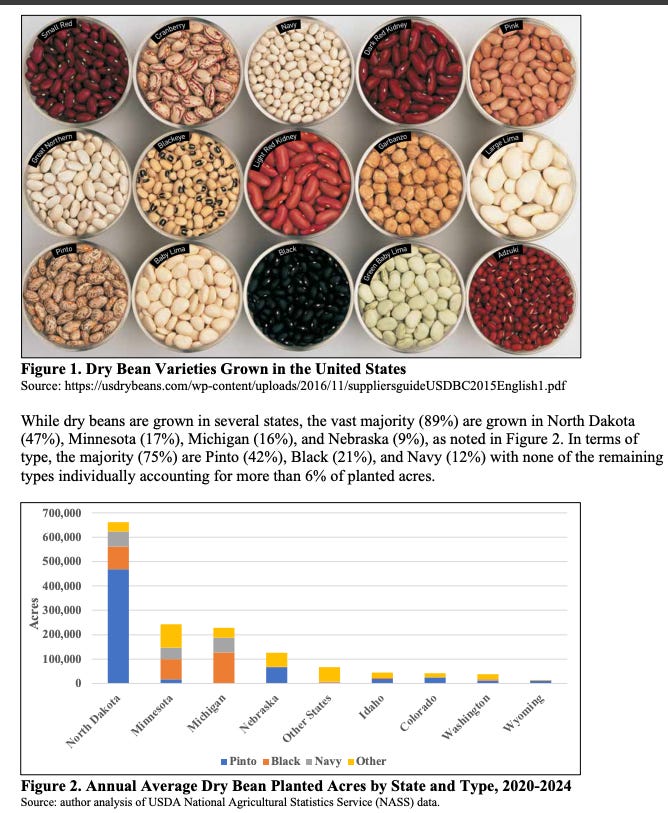
I came across an obscure, “dry” provision in the Farm Bill that could actually help promote a healthier, plant-rich diet. Championed by ND Senator John Hoeven, whose state grows nearly half of US dry beans, the “Dry Edible Bean Study” directs USDA to investigate whether dry edible beans could be added to corn, cotton, oats, rice, wheat, peanuts, soy, and other staples eligible for crop insurance and loans from the federal government. A so-called farm safety net for dry beans would help stabilize production. From a plant-rich diet perspective, the dry edible beans provision could help promote an alternative source of protein to red meat.

TAKE ACTION: Click on Urge your federal representatives to support the “Edible Dry Beans” provision in the Farm Bill and you will see a letter to can send to Congress with just a few clicks (you may have to register with Climate Action Now first).
Thanks for reading to the end! There is a lot to digest in the Farm Bill — it’s not easy to figure out what’s happening with various versions of the bill, what Congress is plotting next, and where citizens might have input. To be continued.